Nam Pla: From Historical Evidence to a Contemporary Condiment

By Tripradap Wangwongwiwat
For Thai people, 'fish sauce' (nam pla) might be such a familiar staple used daily that its special nature is often overlooked. However, by looking back at historical evidence, we discover that this bottle of amber sauce is the culmination of centuries of food preservation wisdom and cultural exchange. Learning the history of fish sauce is more enchanting than just memorizing the past because it helps us understand the unique flavor structure of Thai cuisine and witness the evolution of a local condiment ready to adapt to changing times. From ancient fermentation pits to becoming a universal seasoning in contemporary kitchens, understanding the roots of fish sauce enriches the aesthetic appreciation and dimension of tasting, giving every drop on the plate a meaning beyond mere saltiness.
We sprinkle saltiness on our dishes every day, but have you ever wondered how this bottle of amber sauce has traveled through time? Let's trace historical evidence and ancient wisdom together to discover how 'fish sauce' remarkably advanced from a local fermented liquid to a contemporary condiment.
Evidence of International Trade
One of the earliest tangible pieces of historical evidence reflecting the import and use of fermented seasonings from abroad in Ayutthaya is found in trade records between the Kingdom of Siam and Japan. Kikkoman Corporation notes that soy sauce was exported from Japan to Ayutthaya as early as 1657 CE (2200 BE). This gives us a glimpse that people in the Ayutthaya period were open to using these salty seasonings in their cooking. Initially, trading in these foreign goods, which were more expensive than local products, likely occurred among the affluent—nobles, merchants, and foreigners—before gradually spreading the deliciousness to commoners.

Evidence from La Loubère's Account
About 30 years later, we find accounts of the Siamese consuming fermented fish (pla ra) in the book "Du Royaume de Siam" (Concerning the Kingdom of Siam), published in 1691 CE (2234 BE). Simon de La Loubère, a French envoy who traveled to Ayutthaya during the reign of King Narai the Great, recorded several observations about food and eating
Mention of "Kapi" (Shrimp Paste): He described a type of seasoning resembling mustard, made from "rotten shrimp" (due to poor salt fermentation), which corresponds to the "kapi" used by Thai people.
Mention of "Pla Ra" (Fermented Fish): He spoke in detail about "rotten fish water or pla ra," noting that the liquid in the pla ra jars ebbed and flowed like sea water. He also received a jar of pla ra from Monsieur Vincent to take back to France.
From this record, we can understand the food context of Ayutthaya at that time: kapi (including its liquid, or nam kapi/nam khoi) and pla ra were widespread foods/condiments/flavor enhancers with significant roles in daily life. However, fish sauce (nam pla) was not yet significantly mentioned in La Loubère's accounts.

Mention of Fish Sauce in the Kap He Khlong Prasat Thong Daeng Poem
About 40 years later, during the reign of King Borommakot (between 2276–2298 BE / 1733–1755 CE), Prince Thammathibet Chaiyachet Suriyawong (Prince Kung) , the eldest son of King Borommakot of the Ban Phlu Luang dynasty, was renowned as a "great poet of the late Ayutthaya period." His valuable literary works have been passed down to the present day, including:
Kap He Ruea (Boat Journey Poem): Poems for royal barge processions, admiring fish, trees, and birds (which became a template for composing similar poems in the Rattanakosin era).
Kap He Khlong Prasat Thong Daeng: Describing nature and various wildlife during a royal excursion.
Nanthopanantha Sutra Kham Luang and Phra Malai Kham Luang (Buddhist literary works).
In the Kap He Khlong Prasat Thong Daeng, a poetic work composed to celebrate nature during a journey to Saraburi, passing by Thong Daeng stream (Thong Daeng is a natural stream and historical site in Phra Phutthabat District, Saraburi Province), the poem mentions the abundance of fruits and vegetables encountered along the way. The sight of villagers eating unripe mangoes, sliced and dipped in 'ngapi' (fermented fish paste) and fish sauce (nam pla), indicates that by the late Ayutthaya period, there was indeed a distinct fish sauce different from 'nam khoi' (liquid from shrimp paste). It also shows that Siamese people have had the tradition of eating mangoes with fish sauce for a long time—a practice popular today as sweet fish sauce with mango. However, in that era, the term "nam pla" might have referred to the liquid from fermented fish similar to pla ra, as the recipe for the fragrant, clear, delicious fish sauce we know today was developed over a hundred years later.

Kap He Khlong Prasat Thong Daeng (Composed by Prince Thammathibet / Kung,
circa 2277–2298 BE / 1734–1755 CE, late Ayutthaya period)
Evidence from Siamese Testimonies Recorded by the Burmese
About 10 years after the era of Prince Thammathibet (Prince Kung), we find another historical record confirming the unique existence of fish sauce. This is information from the "City Chronicles (Royal Library Edition)" , better known as the "Testimony of Khun Luang Ha Wat" (or Testimony of Khun Luang Wat Pratu Sithong). This document does not clearly name a single "author" or "compiler." It originated around 1767 CE (2310 BE), when Ayutthaya fell for the second time.
Khun Luang Ha Wat (King Uthumphon) , the 32nd king of Ayutthaya, who had been ordained as a monk and was taken captive to Ava (Burma) along with nobles and Siamese citizens after the fall of Ayutthaya in 1767 CE. He and the ancient royal officials "gave testimony" (recounting
memories) about the geography, social conditions, trade, city plans, and way of life in Ayutthaya to the Burmese authorities. Burmese clerks and interpreters (from the Ava period) recorded these Thai testimonies, translating them into Burmese, in a document called "Yazawin" (Chronicle).
Later, Siamese officials / the Vajiranana National Library (Rattanakosin era) , during the reign of King Rama V, translated the Burmese version back into Thai. This work was led by Prince Damrong Rajanubhab and his team, who edited and published it under the title Testimony of Khun Luang Ha Wat or The Royal Library Document.
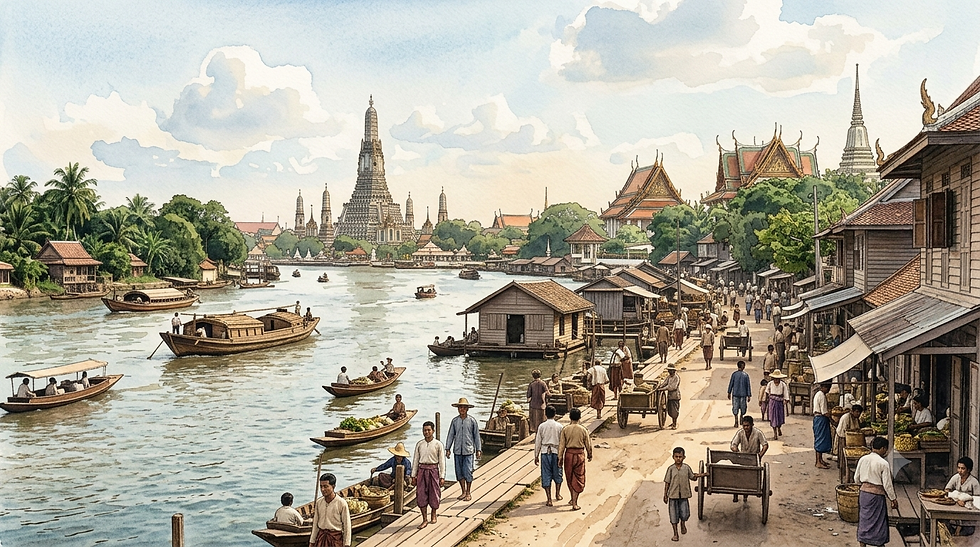
The record mentions commercial ships from coastal provinces (such as Phetchaburi and Samut Songkhram), called "Paktai boats", which brought aquatic animals and preserved seafood products to trade in Ayutthaya. The goods offered for sale included various seasonings and salted foods, such as kapi (shrimp paste), fish sauce (nam pla), salted crab, and dried fish.

The Story of Fish Sauce in the Rattanakosin Era
In the Rattanakosin period, the history of "fish sauce" evolved beyond being a simple homemade fermented condiment or a product sold by measure in floating markets, into a systematic, major seasoning industry central to Thai cuisine.
Early Rattanakosin (Rama I – III): Use in Royal Court Recipes and Dips
During this time, commoners primarily used rock salt and kapi. However, fish sauce (nam pla) and nam khoi began to play a more significant role in the royal court and noble households. They were used to season curries, stews, or to make dips like "sweet fish sauce", which became more widespread, with various recipes being developed as wartime subsided.
Rama IV – V Eras: Language Standardization and the First Cookbook
King Mongkut (Rama IV), around 1853 CE (2396 BE), issued a royal command to clearly define the terms for salty seasonings, distinguishing between "nam khoi" (clear liquid from boiling kapi) and "nam pla" (clear liquid from fermented fish or boiled fish entrails). Furthermore, Dr. Bradley's Dictionary (Akkharaphithan Sabp) of 1873 CE (2416 BE) clearly defined the word "nam pla," indicating that people in Bangkok were becoming widely familiar with and using fish sauce.

Rama VI Era to Post-WWII: The Fish Sauce Industrial Revolution
The turning point that truly popularized fish sauce nationwide came with the arrival of Teochew Chinese in coastal provinces (such as Chonburi, Rayong, Samut Songkhram). They brought techniques for fermenting anchovies from the Gulf of Thailand with rock salt in large wooden vats or cement tanks using specific methods, resulting in clear fish sauce with a fragrant, savory aroma.

In 1919 CE (2462 BE), the first fish sauce factory was established by Mr. Lai Chieng, Sae Thang, a Chinese immigrant with experience in fish sauce production from China. He experimented with fermenting fish and salt in earthen jars for the first time in Thailand, creating the "Bo Daeng" brand fish sauce, which later developed into "Tipros" —considered Thailand's first commercial fish sauce factory.
After World War II, more fish sauce factories gradually emerged along the coast, such as Saeng Thai Fish Sauce (Seafood brand) in Samut Songkhram, and other brands in Chonburi and Rayong, driven by raw material availability. Post-war, salt was de-listed as a controlled commodity. With the end of the war, salt farms in Samut Songkhram, Samut Sakhon, and Phetchaburi resumed full production of rock salt, allowing fermentation plants to purchase large quantities of quality salt at lower prices as a primary ingredient. Fishing also changed; post-war, fishing gear and boats increasingly used engines and trawling/purse seining methods, enabling the capture of large quantities of anchovies—the primary economic fish for fish sauce production—at once. Coastal communities like Chonburi, Rayong, and Samut Songkhram thus had ample surplus fresh fish to process into fish sauce industrially.
Trade also became easier. Post-war, the government improved infrastructure, including roads and waterways, facilitating the transport of bottled fish sauce from the coast to Bangkok and further distribution to various regions. Coupled with Thais shifting from making their own nam khoi to buying convenient bottled fish sauce, the Chinese immigrants who had settled in Thailand began to accumulate capital after the war. This led to the expansion of fish fermentation business networks, the transfer of cement tank fermentation techniques, and bottling systems for sale, creating fierce competition among numerous local brands in coastal provinces during that era.

The 3 Types of Fish Sauce in Thailand
1. Pure Fish Sauce (Nam Pla Thae)
Obtained from naturally fermenting fish or fish residue with salt, without any adulteration from other types of fish sauce or synthetic salty flavorings. It has a natural, fragrant aroma of fermented fish, a smooth, umami-rich taste, and a Total Nitrogen content of not less than 9 grams per liter—a key indicator of quality, flavor, and "authenticity."
Quality Grades: Often subdivided into:
Grade 1 (Nam Nueng / Hua Nam Pla): The first filtrate from fermentation, with the highest concentration, flavor, and nutritional content.
Grade 2 (Nam Song / Nam Sam): Obtained by re-fermenting or boiling the remaining fish residue with salt water.
2. Mixed Fish Sauce (Nam Pla Phasom)
Produced by diluting "pure fish sauce" with salt water or mixing with other safe ingredients (e.g., amino acid solution from protein hydrolysis, soy sauce, flavor/color enhancers). It must contain not less than 50% pure fish sauce by volume and have a Total Nitrogen content of not less than 4 grams per liter (compared to 9 grams/liter for pure fish sauce). This maintains some fish sauce aroma and flavor while being more affordable, suitable for the food industry or general retail use.
3. Dilute/Artificial Fish Sauce (Nam Pradit Pradoi or Seasoning Made from Synthetics)
Produced using vinegar/hydrochloric acid-hydrolyzed protein, artificially flavored, colored, and scented to resemble fish sauce, without undergoing traditional natural fermentation (or containing very little pure fish sauce). This is the cheapest option, low in nutritional value, and must be clearly labeled as such according to law.
Understanding the history of fish sauce adds depth and meaning to every drop on your plate. If you wish to experience the meticulousness of traditional Thai flavors, "Jirakaan" Traditional Thai Restaurant invites you on a journey back in time through carefully selected and crafted ancient dishes.
Come savor the unique harmony, decode the charm of Siamese culinary wisdom, and experience the aesthetic delight of Thai seasonings in the warm, classic ambiance of Jirakal Restaurant.
Reserve Your Table


