
The Epic of "Tom Kha Gai": From Backyard Carminative Herb to a World-Beloved Aromatic Coconut Soup

Written by Tripradap Wangwongwiwat
When speaking of Thai dishes that have captured hearts worldwide, "Tom Kha Gai" (Chicken Galangal Soup) consistently ranks among the very top. Standing out amidst globally acclaimed soups, Tom Kha Gai is renowned for its invitingly creamy white coconut broth, smooth depth of texture, a rich harmony of three key flavors—sour, salty, and a gentle spicy kick at the end—and, above all, its uniquely delicate aromatic fragrance.
Yet, behind the familiarity of today's Tom Kha Gai lies a fascinating historical journey. Stepping back in time reveals that "Tom Kha" originally featured far simpler ingredients than what we see today. It was not the coconut-based Tom Yum soup we know now, but rather a dish dedicated to showcasing the pure aromatic beauty of galangal alone—a culinary masterpiece shaped by over a century of evolution.

The Genesis of Galangal: From Ayutthaya Folk Medicine to Rattanakosin Medical Texts
Before galangal found its way into coconut curry pots, ancestors of the Thai people viewed it not merely as a seasoning, but as a prized herbal remedy.
Galangal (Alpinia galanga) is a rhizome in the ginger family (Zingiberaceae) that thrives across Southeast Asia. During the Ayutthaya period, local healers and villagers relied heavily on nearby fresh herbs. Folk doctors used galangal as an essential household remedy—crushing, boiling, or extracting its juice to relieve bloating, ease flatulence, expel intestinal gas, and treat skin ailments. This practical wisdom of "food as medicine" was passed down orally through daily living for generations.
By the early to mid-Rattanakosin era, this traditional knowledge began to be systematically documented in royal medical treatises. The medicinal properties of galangal were clearly detailed in the Khamphi Sapphakhun Ya (Treatise on Medicinal Properties, later compiled in the Medical Science Textbook during King Rama V's reign) and Khamphi Worayoksan (revised in 1870). Both texts agree that galangal possesses warm therapeutic qualities, a pungent taste, and concentrated essential oils that aid digestion, stimulate blood circulation, and balance the body's elemental humors.
Owing to these medicinal virtues, galangal entered the kitchen. Its initial culinary role was not as a star flavor, but as a "deodorizer." In an era when fresh fish or wild game carried strong gamey odors, cooks pounded galangal and added it to boiling water so its volatile oils would neutralize the smell. In those early days, galangal worked quietly behind the scenes.
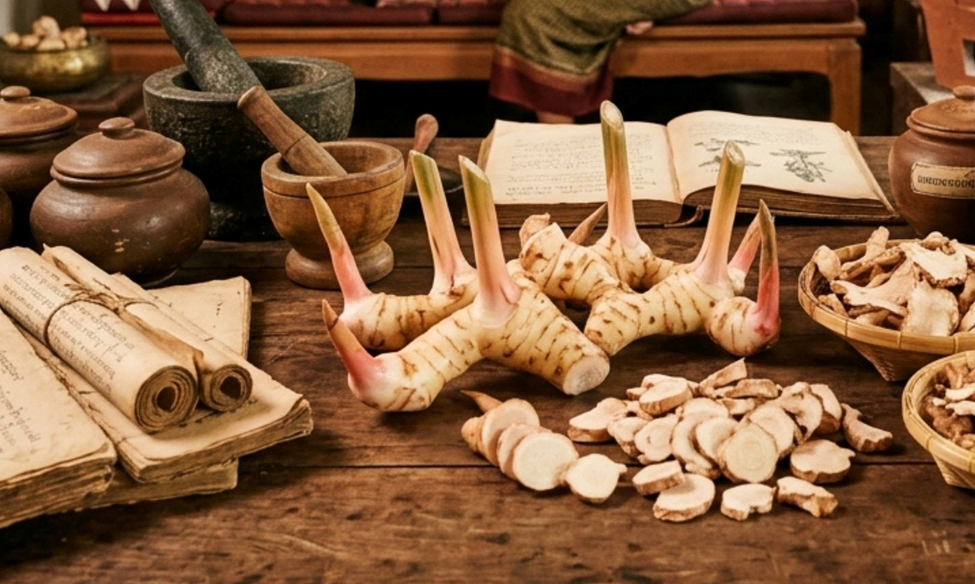
The Singular Aroma Era: When "Tom Kha" Meant Boiling Strictly with Galangal
As ancient cooks discovered that the essential oils of young galangal—when exposed to heat and combined with rich coconut cream—yielded a surprisingly gentle and mesmerizing fragrance, culinary experimentation began.
The original Tom Kha was born out of a desire to highlight the distinct scent of galangal to the fullest, without other herbs competing for the spotlight. Ancient Tom Kha was literally meat boiled with galangal! The defining trait of that era was the purity and lightness of its aroma—there was no lemongrass, kaffir lime leaves, shallots, or fresh bird's eye chilies in the pot at all.
Coconut milk was used to extract and encapsulate the aromatic oils of young galangal as it simmered slowly with the meat. The texture and scent were defined purely by young galangal: rich, creamy, smooth, and deeply aromatic—decidedly different from Tom Yum.
The Charm of the Separate Dipping Sauce: Zest Kept Outside the Pot
Another fascinating aspect of ancient Tom Kha was how it was seasoned. The sour and spicy kick was not created by squeezing lime or throwing chilies directly into the main pot during cooking.
Instead, meat (chicken or duck) was simmered on low heat with thick coconut cream and generous amounts of young galangal until the coconut milk gently separated its oil. The flavor in the pot remained purely rich, savory, and scented with galangal.
The vibrant kick was prepared separately as a dipping sauce (such as fermented soybean dip or a chili paste dip seasoned with sour, salty, and spicy notes). Diners would spoon out the coconut- simmered meat and pair it with the sauce to adjust the spiciness to their liking. Keeping the dip separate preserved the pure milkiness and galangal fragrance in the pot without being overpowered by acid or heat.

Establishing an Independent Recipe: Historical Evidence from 1890
The distinct appeal of galangal-infused coconut broth eventually elevated the dish from a general coconut curry to a dedicated recipe named "Tom Kha."
The earliest written record confirming the existence of Tom Kha appears in Tamra Kap Khao (Cookbook) by Mom Somjeen (Rachanupraphan), published in 1890 (R.S. 109) during the reign of King Rama V—one of the earliest printed Thai cookbooks in history.
Mom Somjeen recorded a recipe titled "Tom Paet Pet Kai Kap Kha On" (Boiled Duck or Chicken with Young Galangal) under the header "Tom Kha," specifying 10 baht (a traditional Thai weight unit) of young galangal simmered in coconut milk with meat. This historical entry demonstrates two key points:
Tom Kha was not limited to duck: While later traditions often favored duck, chicken was already recorded as a main ingredient as early as 1890.
It was a distinct dish: Tom Kha has been recognized for its own unique technique and identity for over 130 years.

From Single Herb to Herb Complex: The Modern Evolution
Over time, Thai dining culture evolved. The traditional Tom Kha—once focused solely on galangal aroma and paired with a separate sauce—began welcoming complementary herbs such as lemongrass, kaffir lime leaves, and shallots into the pot to build a more complex aromatic profile.
Furthermore, sour, spicy, and salty flavors from crushed bird's eye chilies and fresh lime juice were integrated directly into the pot right before serving. This transformed the dish from a delicate galangal-infused broth eaten with dip into a complete, all-in-one coconut soup—sour, salty, spicy, and subtly sweet—which appealed to modern palates and became the global image of "Tom Kha Gai" today.

A Unique Global Appeal
The reason Tom Kha Gai has captured the hearts of both Thais and international travelers is not just its taste, but its comforting harmony.
While "Tom Yum Goong" represents bold, fiery, and sharp sour flavors, Tom Kha Gai offers warmth, comfort, and gentleness. The coconut milk mellows the sharp heat of chilies, while the fragrant galangal cuts through the richness of the coconut cream—creating a balance rarely found in other culinary traditions.

From a medicinal rhizome used by Ayutthaya folk doctors, to written royal medical texts, to slow-simmered aromatic broths, and finally to a celebrated dish on menus worldwide—the story of Tom Kha Gai is more than a culinary history. It is living cultural proof of Thai culinary wisdom that artfully transforms "medicine" into an enduring art of flavor.
If you wish to experience the authentic taste of classic "Tom Kha" that honors the pure, delicate aroma of young galangal, we invite you to Jirakaan. Step back in time with our Classic Tom Kha Pet (Duck) and Tom Kha Gai (Chicken), prepared with fresh ingredients and slow-simmered according to century-old traditions.


