Slurp Like a Local: The Ultimate Guide to Thailand’s Street-Side Noodle Culture

By Tripradap Wangwongwiwat
Thai noodle culture is one of the most fascinating culinary phenomena in the world. While its roots trace back to Hainanese, Teochew, and Hokkien immigrants who settled in Siam from the Ayutthaya period through the Rattanakosin era, Thailand did not merely adopt this foreign dish—it masterfully reimagined, refined, and elevated it into a distinct identity found nowhere else. Siamese cooks blended traditional Chinese noodle-making and soup-braising techniques with vibrant local ingredients such as fresh chilies, fish sauce, lime, palm sugar, coconut milk, and aromatic fermented red tofu sauce. This creative evolution transformed simple Chinese comfort food into an explosion of bold, multi-layered flavors—ranging from the rich depth of Kuay Tiew Ruea (Boat Noodles) and the fiery punch of classic Tom Yum, to the coconut-curry elegance of Northern Khao Soi. It is precisely this artful adaptation that freed noodles from their original boundaries, weaving them into the nation's cultural fabric and continually captivating food lovers from around the globe.

Tracing Noodle Roots from the Mainland: Noodles in Ayutthaya-Era Siam
Tracing the origins of noodles in Thailand reveals that this staple dish is far from a modern invention. Its history stretches back to the Ayutthaya period. However, during its early days, noodles were not yet a widespread favorite among the general Thai population; they remained an ethnic specialty confined strictly to the Chinese immigrant communities who had settled in Siam for trade.

Key historical evidence confirms the presence of noodles during this era. Simon de La Loubère, the French diplomat who visited Ayutthaya during the reign of King Narai the Great (circa 1687), documented the daily life of the Chinese community along the Khlong Khun Krai and Baan Chine districts. He noted their practice of boiling noodle dough to serve with broths and various toppings.
Furthermore, crucial proof appears in the Testimony of King Uthumphon (Khun Luang Wat Pradu Song Tham), an official record detailing the commercial districts and foreign communities of late Ayutthaya. It explicitly states: "...at Baan Khlong Suan Phlu, the Chinese set up distilleries, raised pigs for sale, and manufactured dried rice vermicelli for sale..." This serves as concrete historical evidence that early Siam not only consumed noodles, but had already established domestic production facilities for rice noodles within its Chinese quarters.
During this period, native Siamese diets still revolved almost entirely around rice and fish. Noodles functioned as a distinct "ethnic food," embodying the culinary tradition of Chinese river traders who sold their hot soups from canal boats or market stalls—long before these delicate strands would weave themselves permanently into the fabric of Thai society.
Unbroken Strands: The Continuity of Noodle Culture in the Thonburi Era
Even as the collapse of Ayutthaya during the Second Fall swept away the old capital, the culture of noodle making and consumption did not perish in the flames. The legacy of these delicate strands was seamlessly woven onward by Chinese immigrants fleeing the devastation to the south, joining forces with established local Chinese communities in "Bang Chine" and the bustling waterfront trading districts of Thonburi.
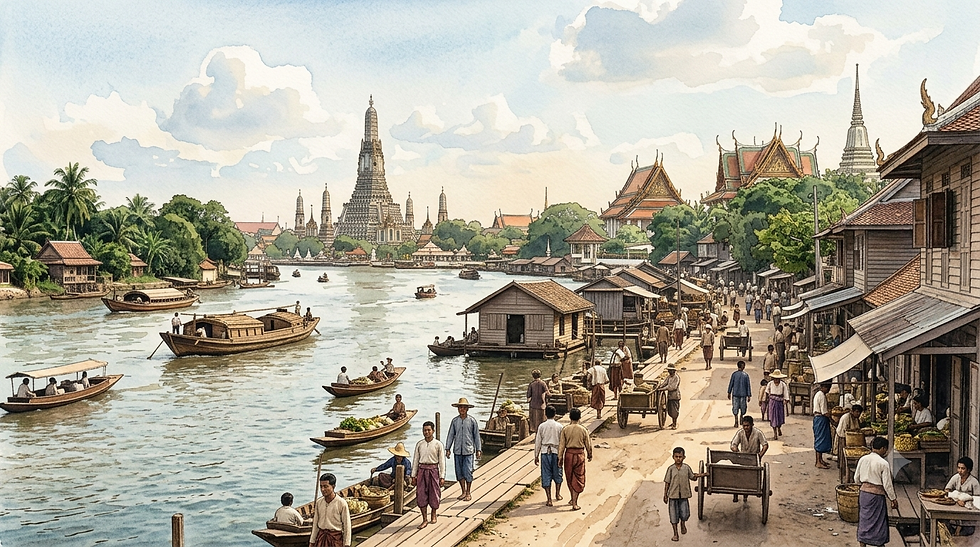
Throughout the 15-year reign of King Taksin the Great, establishing Thonburi as the new capital drew a vibrant wave of Teochew merchants and settlers to key waterways like Khlong Bangkok Yai and Khlong Bangkok Noi. The art of noodle-making and hot broth preparation—once thriving in Ayutthaya’s Khlong Suan Phlu—was instantly revived and preserved. Sold from floating canal boats and humble riverside stalls, noodle soups became a comforting staple that nourished the hardworking Chinese community during this period of national reconstruction, cleanly handing down a rich culinary heritage to the upcoming Rattanakosin era.

From Ethnic Delicacy to Royal Court: Noodles in the Early Rattanakosin Era
During the early Rattanakosin period (King Rama I to Rama III), despite the rapid expansion of Chinese settlements in districts like Sampheng, noodles remained strictly an ethnic delicacy consumed almost exclusively within the Chinese immigrant community. While native Thais may have sampled them occasionally at market stalls, noodles were far from a staple in everyday Thai dining.
This reality is vividly reflected in the literature of the era. The Kap He Chom Khrueang Khaw Wan (Boat Song Admiring Savory and Sweet Dishes), authored by King Rama II—the most influential culinary record of early Rattanakosin—extensively details various delicacies, including dishes of Malay, Javanese, and foreign origin. Yet, it makes no mention of noodles whatsoever, underscoring that noodles were not yet considered part of mainstream Thai culinary identity.

The turning point emerged during the reign of King Rama IV, captured through a dramatic royal court record. Historical documents detail how Chao Chom Manda Kleeb, a trusted royal consort managing the palace kitchen, prepared Kaeng Kuay Tiew (curried noodles) and noodle soup for King Pin Klao (the Second King of the reign). During the meal, an unexpected anomaly in the bowl ignited suspicions, spiraling into a famous court trial involving accusations of black magic and love potions.

Beyond the drama of palace intrigue, this trial yields a vital piece of food history: it provides concrete proof that by the mid-19th century, noodles had crossed the threshold from Chinese street food into the royal kitchens, serving as a dish presented directly to Siamese monarchs.
Noodles in the Reign of King Rama V: Street Food for the Working Class, Absent from Formal Tables.
During the reign of King Chulalongkorn (King Rama V, 1868–1910), Siam entered an era of comprehensive reform, marked by the rapid growth of printing houses and the publication of numerous cookbooks to disseminate knowledge. However, from a socio-cultural perspective, noodle dishes remained humble, quick meals consumed primarily by Chinese laborers, far from being accepted onto formal dining tables.

As Bangkok expanded its infrastructure through new roads, canals, and shop-houses, it drew a massive influx of Chinese immigrant labor—coolies, canal merchants, and skilled artisans. Noodles served as an ideal street food: cheap, energy-dense, and quickly served from canal boats or roadside stalls. Yet, in the eyes of the Siamese elite and general population, noodles were still viewed as ethnic Chinese street food lacking the refinement required for royal banquets, hosting foreign dignitaries, or serving as a staple in traditional Thai households.
This reality is vividly demonstrated by the three most significant cookbooks of the era, all of which completely bypassed noodle dishes:
amra Kap Khao (1890) by Mom Som Jeen Rajanuprapan, one of the earliest printed Thai cookbooks.
Prathanukrom Kan Tham Khong Khaw Khong Wan Yang Farang Lae Siam (1898) by the Wang Lang Girls' School.
Tamra Mae Khrua Hua Pa (1908) by Than Phu Ying Phlian Bhaskarawongse.

These seminal texts meticulously documented intricate traditional curries, dips, Western dishes, and popular Chinese fare. Yet, not a single page mentioned noodle dishes. This underscores that while the aroma of noodles wafted through alleyways and canals, during the golden age of cookbook publishing in the Rama V era, noodles remained strictly the food of Chinese coolies—yet to cross the class barrier onto Siam's formal dining tables.
From Coolie Street Food to a "National Rescue Heritage": The Turning Point of Siamese Noodles under Field Marshal Plaek Phibunsongkhram
While noodles were overlooked and absent from high-society cookbooks during the reign of King Rama V, in daily life, these delicate strands quietly penetrated deep into the fabric of Siamese society. Along alleyways and canals, their accessibility, customizability to local palates, and affordable pricing transformed noodles into a steadily beloved street food among native Thais.
However, the definitive turning point that propelled noodles across class lines—from a mere "quick street bite" to a true "National Dish"—emerged from the political, economic, and social crises of the 1940s.

Compounding Crises — World War II and the Great Flood of 1942
Following the 1932 Revolution, Thailand weathered ongoing political turbulence that culminated in the outbreak of World War II. The war devastated the national economy, driving up prices and creating severe rice shortages across the country.

The crisis reached its peak when The Great Flood of Bangkok hit in 1942, submerging vast agricultural lands and destroying rice paddies. Faced with widespread food scarcity, the government under Field Marshal Plaek Phibunsongkhram desperately needed a rapid solution to prevent mass hunger.

The government's answer was not to ration scarce rice reserves, but to shift the eating habits of the entire nation by adopting noodles as their primary vehicle. Rice noodles required only a small fraction of rice flour combined with water, bean sprouts, local vegetables, and tiny portions of meat—drastically reducing national rice consumption while keeping the population fed.
The National Campaign "A Bowl of Noodles a Day" and Cultural Nationalism
Field Marshal Phibunsongkhram did not view noodles merely as an emergency substitute, but utilized them as a prominent symbol of "Modern Thainess" and his Rathaniyom (Cultural Mandate) policy. This initiative aimed to diminish foreign commercial dominance and foster economic self-reliance by urging Thais to support Thai merchants.

The government launched a nationwide propaganda campaign under the catchy slogan "Eat a bowl of noodles every day." Leveraging mass media, radio broadcasts routinely played the official "Noodle Song" via the Public Relations Department to rebrand noodles as a modern, hygienic, and patriotic choice:
"Noodles are here! Noodles are here!
Beef noodles, pork noodles, chicken noodles.
Made from local produce, born entirely in the Thai State,
Riches of the land available everywhere—
Let us buy and sell together to prosper..."
Government Support — From 30-Baht Seed Money to 8 Official Recipes
To turn policy into practice, the government built a comprehensive ecosystem supporting noodle production and vendor livelihoods:
30-Baht Starter Subsidies: The state allocated 30 baht per person in seed funding—a sum sufficient to purchase bowls, blanching pots, and build a wooden pushcart or shoulder-pole kit—encouraging citizens to become street noodle vendors.
Publishing 8 Official Government Noodle Recipes: The Department of Public Welfare published standardized recipes in major newspapers (such as Sri Krung in 1942) so the public could cook and sell them. Featured dishes included Pork Noodles, Beef Noodles, Chicken Noodles, Stir-fried Noodles with Bean Sprouts, and Coconut-fried Noodles.
Infrastructure & Hygiene: State-run factories were established to manufacture rice noodles and glass noodles to guarantee raw supply, alongside mandatory sanitation workshops for vendors to elevate cleanliness standards.

Cultural Legacy: From Crisis Food to Thai Identity
The intense wartime campaign permanently reshaped how Thais ate. Street noodles—once considered humble Chinese coolie fare—were adapted with local seasonings: dried chili flakes, fish sauce, vinegar, and sugar, perfecting the art of table-side customization (Pruang Prung) tailored to the Thai palate.
The crisis of 1942 ultimately served as the catalyst that stripped noodles of their ethnic-only stigma, elevating them into an indispensable national staple and one of Thailand's most enduring culinary legacies.
Curbside Heritage: From National Campaign to Street-Corner Noodle Haven
Stroll down any street, alleyway, or wet market in Thailand today, and the sight of steam billowing from stainless-steel cauldrons alongside the comforting sounds of noodles being blanched is unmistakable. The reality that "you can find a noodle shop every 100 meters" is no coincidence. It is the direct legacy of foundations laid by Field Marshal Plaek Phibunsongkhram’s government over eighty years ago.
That wartime Cultural Mandate policy did more than just elevate noodles into a national dish; it fired the starter pistol for an explosion of culinary creativity across Thailand.
As government seed money of 30 baht and official recipes spread, generations of Chinese immigrants fully integrated into Thai society. Pairing their culinary mastery with local ingredients and regional flavors, Thais and Thai-Chinese cooks began relentlessly tweaking, inventing, and mastering their own unique noodle recipes.
From zesty Kuay Tiew Tom Yum laced with fresh lime and roasted chili flakes tailored to native palates, to the intensely savory boat noodles of Khlong Rangsit; from braised chicken noodle soup with bitter melon and Hakka-style Kuay Tiew Khek, to vibrant pink Yentafo and tender stewed beef soups simmered with Chinese herbs for dozens of hours—each variation was polished over time into an incredible regional diversity unlike anywhere else in the world.
Today, noodles are woven directly into the DNA of Thai life. No longer a mere wartime emergency ration, a bowl of noodles fulfills far greater roles Affordable & Filling, An everyday meal priced for everyone. Warm & Comforting, simple to eat, soothing to swallow, serving as ultimate comfort food in a steaming bowl of broth after a long day. The Ultimate Table-Side Freedom—adjusting fish sauce for saltiness, sugar for sweetness, pickled chili vinegar for tang, or fresh lime juice and ground chili for fiery heat A personalized single-bowl dish where diners act as their own chef
From humble steamed rice-flour strands in Ayutthaya’s Khlong Suan Phlu, through royal court skepticism, to a sweeping national campaign... noodles stand ready to reveal their captivating variety and charm.
Let’s dive in and explore the astounding range of Thai noodles waiting for you to try!
Ordering noodles at a Thai street food stall might seem straightforward to locals, but for beginners, the real fun starts with choosing the "Noodle Type" (Sen). The noodle is the soul of the bowl, defining its texture and overall flavor experience.
If Thai noodles are an art form, the noodle itself is the canvas, waiting for the right broth to bring it to life. Learning these basic noodle types is your first step toward ordering like a true Thai local.

A Beginner’s Guide to Thai Street Noodles
Rice Noodle Family: White noodles made from rice flour, forming the backbone of Thai noodle culture.
o Sen Yai (Flat Rice Noodles): Wide, chewy rice sheets that absorb soup beautifully. Commonly paired with Yentafo, clear soup noodles, or stir-fried dishes like Pad See Ew and Rat Na.
o Sen Lek (Thin Flat Rice Noodles): The most popular everyday noodle with a balanced, chewy texture. It is the gold standard for Pad Thai and Boat Noodles (Kuay Teow Reua).
o Sen Mhee (Rice Vermicelli): Very thin, delicate rice strands. Ideal for clear soups, fish ball noodles, or for those who prefer a light texture that lets the broth shine.
o Sen Kuay Jab (Rolled Rice Noodles): Square rice sheets that roll into tight tubes when cooked. Exclusively used in Kuay Jab (broth served with pork offal and crispy pork).
o Kiam Eei (Needle Noodles): Short, thick rice noodles tapered at both ends like needles. They offer a satisfying, soft chew, traditionally found in minced pork or classic fish ball noodle soups.
Egg Noodle Family (Sen Ba Mhee): Yellow noodles made from wheat flour and eggs, offering a rich aroma and springy texture.
o Sen Ba Mhee Klom (Round Egg Noodles): The standard thin, round egg noodle used in Tom Yum, wonton noodles with roasted pork, or duck noodles.
o Sen Ba Mhee Ban (Flat Egg Noodles): Medium-flat egg noodles that cling to sauces and rich broths exceptionally well—perfect for dry noodles.
o Sen Ba Mhee Poh (Wide Flat Egg Noodles): Extra-wide egg noodles with a delightful chew. Commonly found in Cantonese-style roasted duck noodle shops, Betong noodles, or Northern Thai Khao Soi.
Glass Noodle Family:
o Woon Sen (Glass / Mung Bean Noodles): Clear, translucent noodles made from mung bean starch. Low in calories and light, they are popular in Tom Yum soups and Sukiyaki.
Now that we are familiar with the noodles, let's explore the common types of noodles found throughout Thailand.
Fish Ball Noodles (Kuay Teow Luk Chin Pla)
A noodle soup or dry noodle dish. The toppings include fish balls, fish cakes (both fried and un-fried), fish dumplings, Hakka-style stuffed tofu/meatballs, shrimp balls, crispy fish skin, and crispy wontons. The vegetable used is mostly bean sprouts. It is usually sprinkled with fried garlic and chopped spring onions before serving. Most of the broth is boiled from pork bones, chicken bones, or a mixture of both, simmered together with various light-colored spices.

In fish ball noodle shops, a menu item always found alongside is Yentafo (Pink Noodle Soup). The available topping options are the same as fish ball noodles, with additions such as crispy squid, jellyfish, white fungus mushrooms, tofu puffs, pork blood cubes, and Thai water spinach. Yentafo has a pinkish-red color. Yentafo sauce is made from fermented red bean curd, mixed with red chilies (some non-spicy recipes omit the chilies), Thai tomato sauce, pickled garlic, vinegar, and palm sugar, resulting in a predominantly sweet taste followed by sourness. The sauce effectively cuts the fishy odor of fish balls and shrimp balls, pairing exceptionally well with crispy squid and jellyfish, which deliver a wonderful hint of the sea.

Another style you will encounter in fish ball noodle shops is Tom Yum Noodles. The toppings are chosen from whatever is available in the shop; simply ordering "Sen Lek Tom Yum" (thin rice noodles Tom Yum style) prompts the vendor to add fish sauce, sugar, lime juice, vinegar-pickled chilies, fine dried shrimp, roasted peanuts, and chili powder to make the dish rich and bold in flavor. Keep in mind that this Tom Yum noodle dish is not like the standard Tom Yum Goong that incorporates lemongrass, kaffir lime leaves, and galangal.

Pork Noodles (Kuay Teow Moo)
Pork noodle shops are a cornerstone of Thai street food culture, found on nearly every street corner—from roadside carts to historic shophouses. The soup features a cheng (clean, clear) pork bone broth that is aromatic, mild, and soothing to drink. Pork noodles come in a wide variety of styles, including clear broth pork noodles, braised pork noodles, egg noodles with roasted red pork, pork boat noodles, pork Tom Yum noodles topped with a soft-boiled egg, and Sukhothai-style pork noodles served with sliced long beans.

Beef Noodles (Kuay Teow Neua)
A classic favorite among meat lovers in Thai street food, this dish is distinguished by a rich, deeply flavorful broth infused with the aroma of Chinese herbs and spices like star anise and cinnamon, slow-simmered with beef bones for hours. You can pair your choice of noodles with an array of generous toppings, including melt-in-your-mouth braised beef, tender sliced fresh beef, bouncy beef balls, and flavorful offal. Enhanced with aromatic fried garlic and fresh herbs, it can be enjoyed either as a piping-hot soup or dry-tossed with dark soy sauce, fully customizable to your preferred balance of spicy, sour, and sweet using the condiment set on the table.

Chicken Noodles & Duck Noodles (Kuay Teow Gai / Kuay Teow Ped)
Chicken and duck noodles are two popular Thai street food staples distinguished by their aromatic broth infused with Chinese spices and meat simmered until tenderly rich in flavor. They are ideal options for those who do not eat beef or pork.
Chicken Noodles: Generally divided into two main styles: Braised Chicken Noodles featuring a rich dark soy sauce broth simmered with Chinese spices, served with large cuts of braised chicken, bitter gourd, or tender chicken drumsticks; and Shredded Chicken Noodles in a light, clear chicken bone broth (cheng) with a smooth aroma, served with shredded boiled chicken that is light and easy to enjoy.
Duck Noodles: Renowned for their premium quality and deep, rich flavor derived from a broth crafted with Chinese five-spice herbs such as star anise and cinnamon. Served with tender braised duck, rich duck blood cubes, or roasted duck with fragrant, crispy skin, this dish is traditionally paired with egg noodles or wide rice noodles (Sen Yai), alongside pickled chili vinegar to cut through the richness.

Thai Guay Jub & Vietnamese Guay Jub (Guay Jub Thai / Yuan)
Guay Jub is another flavorful, soup-centric noodle dish that has long held a cherished place in Thai cuisine. In Thailand, it is primarily divided into two distinct, iconic styles:
Thai Guay Jub: Highlighted by its unique rolled rice noodle sheets, which offer a chewy yet tender texture. It comes in two broth variations:
o Dark Broth (Nam Khon): A rich, aromatic five-spice broth featuring a balanced savory-sweet flavor. It is served with crispy pork belly, sliced pork, fried tofu, braised hard-boiled eggs, and pork offal.
o Clear Broth (Nam Sai): A clean, light pork bone broth (cheng) packed with a fiery, nasal-clearing punch of crushed white pepper (in classic Yaowarat style), showcased alongside generous chunks of crispy pork belly and minced pork.
Vietnamese Guay Jub (Guay Jub Yuan): A signature northeastern Thai noodle dish with Vietnamese roots. It features fresh rice noodles boiled directly in the broth, giving them a chewier texture and creating a slightly thickened, hearty soup. The sweet, comforting pork bone broth is topped with Mu Yor (Vietnamese pork sausage), minced pork, tender pork ribs, crispy fried shallots, and finely chopped spring onions.

Seafood Noodles (Kuay Teow Thale)
Seafood Noodles is a dish that seamlessly blends the natural, sweet freshness of the ocean with Thai noodle culture. Perfect for lovers of bold, vibrant flavors and fresh seafood, it is most commonly found in coastal towns, with strong presences in provinces like Chonburi, Rayong, and Chanthaburi.

Rad Na & Pad See Ew (Stir-Fried Rice Noodles with Gravy and Soy Sauce)
Rad Na and Pad See Ew are two Thai-Chinese stir-fried noodle dishes that are routinely served together in the same shops. Both highlight the technique of tossing wide rice noodles or thin rice vermicelli over high heat in a cast-iron wok, creating a signature smokiness known as Klin Kra-tha (wok hei) that gives the dishes their distinct charm.
Rad Na: Distinguished by its savory, smooth gravy, thickened to perfection with tapioca or corn starch. The gravy is simmered with crisp Chinese kale and tender marinated meat (pork, beef, or seafood), then poured over fragrant stir-fried noodles or crispy fried egg noodles.
Pad See Ew: A dry stir-fried noodle dish featuring a balanced savory and sweet flavor profile. Wide rice noodles are wok-fried over intense heat with sweet dark soy sauce, eggs, Chinese kale, and your choice of meat until the soy sauce caramelizes and absorbs into the noodles, yielding a deeply fragrant, tender texture.
Both dishes are easy-to-eat, non-spicy street food staples that can be customized at the table with chili flakes, pickled chili vinegar, and sugar according to personal preference.

Pad Thai (Stir-Fried Rice Noodles)
The defining signature of Pad Thai lies in stir-frying Sen Chan (chantaburi rice noodles) or standard thin rice noodles until perfectly chewy and tender, thoroughly coated in a well-balanced sauce built on the classic three-flavor profile (Sam Rot): tartness from tamarind paste, sweetness from coconut palm sugar, and savory saltiness from fish sauce.
The noodles are wok-tossed with egg, diced yellow firm tofu, sweet chopped preserved radish, dried shrimp, and large fresh prawns. Fresh bean sprouts and Chinese chives are added right at the end and flash-fried over high heat to retain their crisp crunch. It is traditionally served topped with crushed roasted peanuts, chili flakes, and a side of fresh raw vegetables—alongside a crucial fresh lime wedge to squeeze over the dish for a bright, aromatic burst of acidity before eating.

Noodles in Thailand are far more than a convenient street-side quick bite; they represent the culmination of a profound journey and culinary cultural evolution. From their humble beginnings as a niche staple among Chinese immigrants during the Ayutthaya period, noodles gradually wove themselves into the fabric of Thai society across eras. They reached a pivotal turning point in the 1940s, when national campaign policies transformed this quick street food into a tool for economic growth and new cultural values—marking the true fusion of traditional craftsmanship with local Thai ingredients.
What sets Thai noodles apart from noodle traditions in other countries is their deep dimension of variety and openness to flavor personalization. The journey of noodles on Thai soil gave birth to uniquely regional recipes: from the rich, complex depth of Kuay Teow Reua (Blood-Thickened Boat Noodles) and the fiery, fresh-lime zest of traditional Tom Yum, to the warm, aromatic comfort of five-spice braised duck and chicken broths, the charming sweet-and-sour profile of Yentafo, and the smoky wok aroma of Rad Na, Pad See Ew, and Pad Thai.
Furthermore, Thai noodle culture grants full freedom of customization, offering a vast range of noodle textures to choose from and a condiment set at every table that empowers diners to shape the bowl's final flavor profile themselves. All of this combines to ensure that noodles in Thailand are not merely a daily meal, but a living street food heritage—ready to offer an endless journey of new flavor experiences in every single bowl.
If your love for Thai cuisine makes you want to delve deeper into its rich culinary history, treat yourself to Rattanakosin-style Thai dining at Jirakaan, located on Sukhumvit 51, Bangkok.


