
🍤 A Slurp That Shakes the World! "Tom Yum Goong," the Billion-Baht Soup That Originally... Had No Prawns?

By Tripradap
When it comes to "Tom Yum Goong," there is probably no one on Earth who doesn't know it. This vibrant orange soup, featuring a fiercely sour, salty, and spicy flavor profile, has become a legendary national dish and symbol of Thailand. It is so globally famous that foreigners had to include the word in their dictionaries. In fact, the name of this very dish was once used to dub a global economic meltdown: the "1997 Tom Yum Goong Crisis."
But did you know? Beneath this world-class spiciness lies a "secret" and a "culinary fashion evolution" with a plot twist that many would never expect.
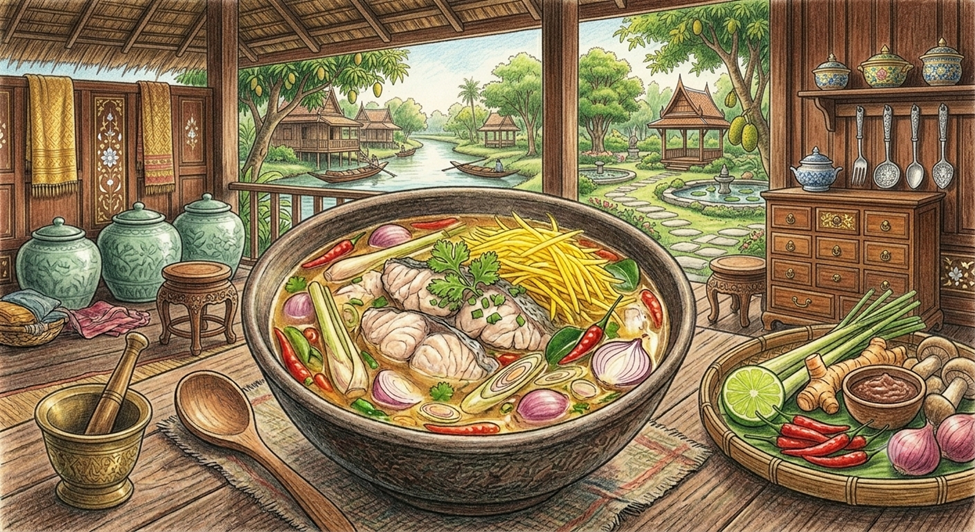
🐟 The Big Surprise: The True Origin Was Actually... "Tom Yum Pla" (Fish Tom Yum)!
If you were to go back in time and ask elders in rural provinces like Suphan Buri, Ang Thong, Sing Buri, or Chai Nat, "Did you eat Tom Yum Goong often when you were young?" the majority of their answers might shock you. They would tell you,
"Back in the day, there was no Tom Yum Goong. There was only Tom Yum Pla!"
Traditional Thai food culture primarily revolved around eating freshwater fish because ancient Siam was incredibly abundant with them. They were easy to find, tender, and delicious.
Excellent evidence of this can be found in Khun Chang Khun Phaen, an epic masterpiece by Sunthorn Phu, the great poet of the Rattanakosin era, which mentions "Pla Tom Yum" as a dish representing a young woman's culinary prowess. Even during the reign of King Rama V, when his Majesty made informal royal excursions, the favorite dish local governors prepared for him was "Tom Yum Pla Chon" (Snakehead Fish Tom Yum). All of this reflects that in its earliest days, prawns hadn't even jumped into the Tom Yum pot yet.
📜 Unveiling the 1891 Secret Recipe: Ancient Tom Yum Had No Kaffir Lime Leaves, No Galangal, and Used Shrimp Paste?!

To get a clearer picture of ancient Tom Yum, we have to look at the oldest surviving evidence available today: the cookbook "Tam Ra Gap Khao" (spelled according to the original text) by Mom Somchin Rachanupraphand, published in 1891 (B.E. 2434). That manual features recipes for all kinds of Tom Yum—from snakehead fish, termitomyces mushrooms, and eel, to chicken and even frog.
But the most mind-blowing part is the ingredients, which make it look like a completely different dish compared to today! Ancient Tom Yum ingredients weren't just galangal, lemongrass, kaffir lime leaves, and chilies. Instead, they included:
Uncooked rice
Uncooked rice
Lemongrass
Roasted dried foreign chilies
Shallots & roasted garlic
Coriander root & salt
Shrimp paste (Kapi)
Sugar & lime
Pickled garlic juice & shredded green mango
Garnished at the very end with fried garlic and fresh coriander
As you can see, the Tom Yum of 1891 used no kaffir lime leaves and absolutely no galangal! Instead, it boasted a complex, multi-dimensional flavor profile: umami from the shrimp paste, a mellow sweet-and-sour note from the pickled garlic juice and shredded mango, and a rich aroma from the fried garlic. The taste profile back then must have been vastly different from today's version, before the Tom Yum pot dynamically evolved and shed ingredients until only a few staple herbs remained.

👑 The River Prawn Era: The Ultimate Luxury Dish for the Wealthy
So how did Tom Yum Goong become the absolute king of the soup pot? The reason ancestors didn't cook Tom Yum Goong at home wasn't because they didn't want to, but because giant river prawns (giant freshwater prawns) were incredibly rare and way too expensive for the average person.
Catching massive river prawns back then wasn't as simple as casting a net for fish. Catchers had to be expert divers or float a boat out at night to scoop them up.
Therefore, ordinary villagers who caught them usually sold them for a premium. River prawns became a status symbol of wealth, taste, and a luxury reserved only for the affluent.
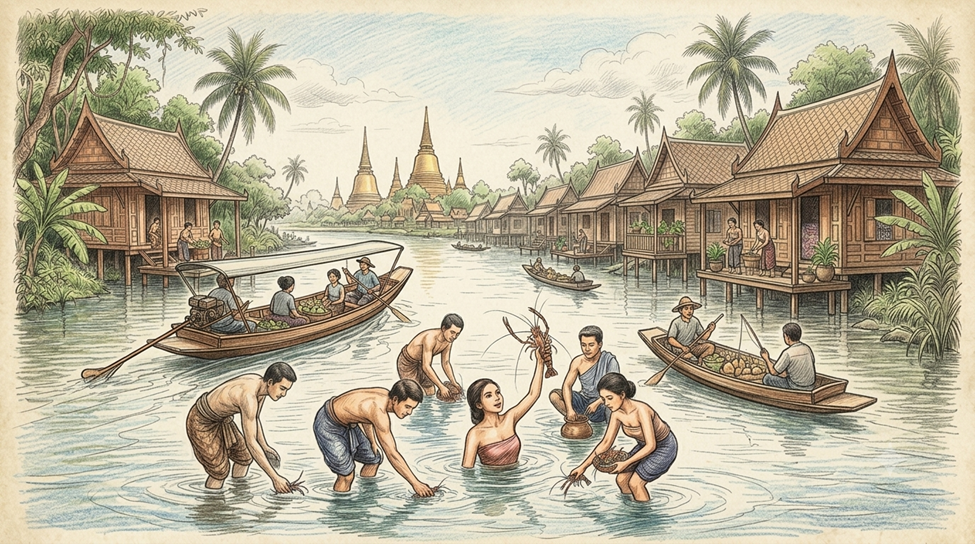
The turning point that popularized and put "Tom Yum Goong Mae Nam" (River Prawn Tom Yum) on the map was historic Chinese restaurants and diners in Bangkok (such as Silom Restaurant, Mit Ko Yuan, Fook Mui Kee, and Phong Lee). They took large river prawns with oozing orange head fat and turned them into signature dishes. This created a smooth, naturally sweet flavor topped with a layer of gorgeous, natural prawn fat. Notably, the original giant prawn Tom Yum at these establishments didn't even need galangal or roasted chili paste (Nam Prik Pao) because the prawn fat provided stunning color and an inherently rich aroma on its own
🚀 From River Prawns to "Sea Prawns": A Leap to Becoming the People's Global Dish
How did Tom Yum Goong become accessible to everyone?
The answer lies in the mid-1970s (around 2510 B.E. onwards), when Thailand experienced a massive boom in marine prawn fishing and aquaculture—especially black tiger prawns and banana prawns. This made sea prawns widely available and much cheaper, eventually turning Thailand into a leading global exporter of prawns.
With cheaper sea prawns, the growth of restaurants, urban trends of eating seafood, and improved logistics, Tom Yum Goong was no longer an exclusive luxury. It transformed into "Tom Yum Goong Thale" (Sea Prawn Tom Yum)—accessible, intensely flavorful, and capable of crossing oceans to plant its flag of popularity worldwide, especially in the US and Europe.
💡 Fun Fact: When transitioning to sea prawns—which have less head fat and might lose some freshness during transport—Thai cooks brought back wisdom from "Tom Yum Pla". They reintroduced galangal and roasted chili paste to mask any fishiness and enhance the visual appeal, resulting in the iconic creamy (Nam Khon) and clear (Nam Sai) versions we enjoy today.
🍲 Conclusion: A Spiciness That Never Stands Still
From fish and various proteins in the 1891 ancient cookbook rich with multi-dimensional seasonings, to the fat-oozing giant river prawns in upscale restaurants, and finally to the globe-trotting sea prawns, "Tom Yum Goong" is prime evidence that Thai food never stands still. It is always ready to adapt, transform, and grow alongside the dynamics of the times.
The next time you enjoy a spoonful of Tom Yum Goong... remember its century-long journey. You will realize that this bowl of soup isn't just great in taste; it has a historical story that is just as rich and fascinating as the heat inside the pot.

If you want to try the ancient Tom Yum recipe directly from Mom Somchin's 140-year-old cookbook, you can experience it at Jirakarn Restaurant in the course “Culinary Journey of Siam, 10 Dishes thru 10 Reigns.”
Thank you for the important information from:
Food, Culture, Health by Professor Dr. Thawithong Hongwiwat, published by Saengdaet Publishing House.
Tamra Kap Khao (A Treatise on Rice and Food) by Mom Somjin Rajanupraphan, published in 1891 (B.E. 2434).


