"Krathong Thong" – A Royal Thai Snack with Origins in Penang's "Top Hat"

อัปเดตเมื่อ 19 ส.ค.
By Tripradap W.
When talking about delicious ancient Thai appetizers often served at auspicious events or to welcome distinguished guests, many people think of "Krathong Thong" – crispy fried pastry cups shaped like tiny bowls, packed with a well‑seasoned filling. But did you know that this dish has deep roots and a historical tale connected to Peranakan culture and King Rama V's royal visit to the South?
Today, we'll take you back in time to discover the origin of Krathong Thong – from a European‑style top hat to a beloved Thai snack.
The Beginning: A Welcome Banquet in Penang
After King Rama V (King Chulalongkorn) returned from his royal visit to Penang, a grand reception banquet was held on the ship of Phraya Rattanasetthi, a wealthy and renowned tycoon of Penang.
At that banquet, many dishes were served, but one that particularly caught the eye – and the palate – of the royal entourage was a local Peranakan (Baba‑Nyonya) snack called "Peranakan Top Hat" – also known as Pie Tee.

Why "Top Hat"?
Because the crispy fried pastry shell is deep, tall, and flares out at the rim, closely resembling a European gentleman's top hat of the era. The filling is a savoury stir‑fry of jicama (yam bean), prawns, crab, cucumber, and corn.
The Journey to Siam and Transformation into "Krathong Thong"
The delicious taste and unusual shape of the Peranakan Top Hat so impressed the courtiers and members of the royal entourage that they ordered the moulds and frying equipment to be brought to Thailand. Soon after, this snack became widely popular in Siamese society.
Once in Thai hands, the dish was creatively adapted and adjusted to suit local tastes:
Variety of fillings: Thais began experimenting with other seasonings and ingredients, giving rise to fillings such as stir‑fried chicken with corn, prawns, or minced pork in a Thai style.
Art of fryi
ng the shell: Traditional Thai cooks developed a delicate technique of "jerking the mould" to create a beautifully flared brim that resembles a soft hat brim – a method recorded in the old Saiya Samakhom cookbook.
Solid Brass Moulds: The Secret to Long‑lasting Crispness – A Vanishing Craft
The true charm of authentic Krathong Thong lies not only in the filling but also in the shell itself. The traditional method differs greatly from today's:
Feature | Traditional Krathong Thong Mould | Modern Krathong Thong Mould |
Material | Solid brass – heavy | Common metal – lightweight |
Heat conductivity | Uneven heat retention |
|
Resulting shell | Stays crisp for a long time; resistant to humidity | Becomes soft quickly if left out |
Shape variety | Deep cup, shallow cup, flared rim, straight rim | Usually uniform – shallow and small |
Later, for convenience and ease of preparation, Thais modified the moulds to be shallower and smaller. This made the snack easier to produce, but the old‑style solid brass moulds and the traditional hand‑flicking frying technique have become a rare craft, almost disappearing over time.
Krathong Thong, therefore, is not just a tiny snack to nibble on. In each bite lies historical memory – a story of travel, cultural exchange between Thailand and the Peranakan world, and the wisdom of ancient Thai cooks who adapted a foreign dish into a beautiful "Thai identity."
Krathong Thong at Jirakaan Restaurant
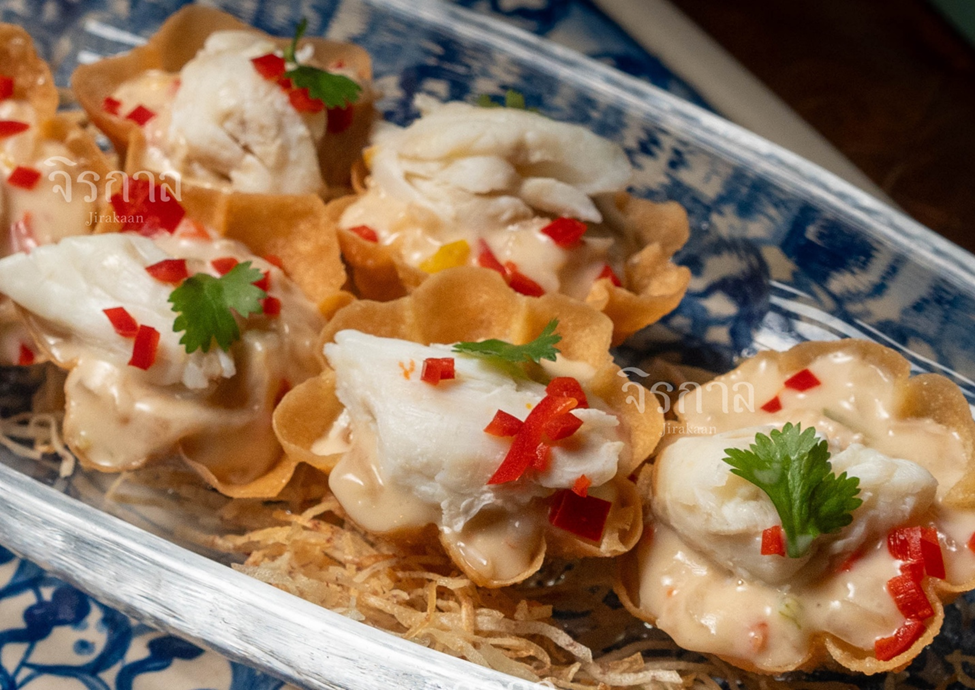
Experience a new chapter of flavour... when Krathong Thong is served alongside authentic "Lon Pu Ma" (Blue Crab Dip).
Chef Most elevates this familiar ancient Thai snack to something extraordinary by harmoniously blending two culinary identities. The Krathong Thong shells are fried until perfectly crisp and beautifully pleated, then filled with a delicate, creamy Lon Pu Ma – a traditional blue crab relish made with generous chunks of crab knuckle meat. This creates a special dish for your special meal, carrying a story in every bite that turns an ordinary dining moment into a truly delightful experience.