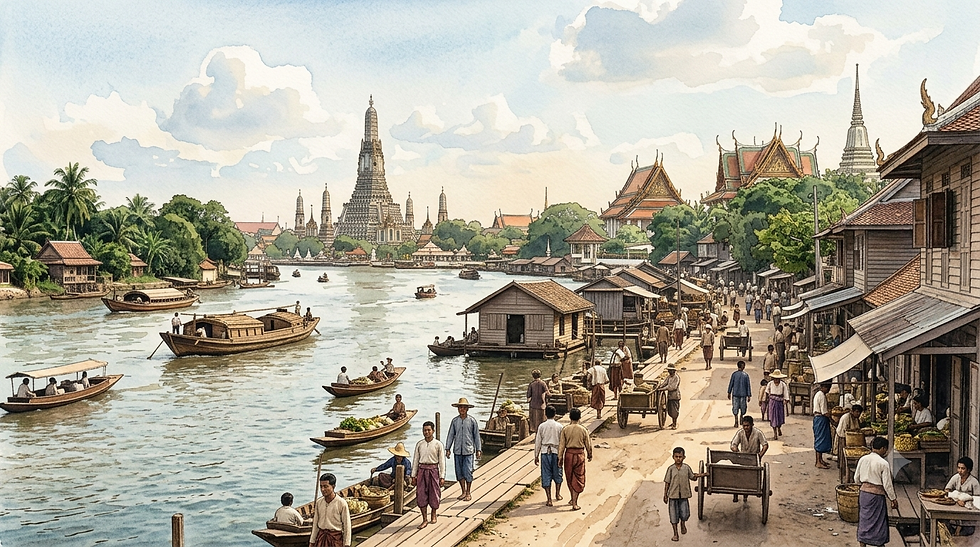
The Secret Behind Thai Culinary Excellence… Cooked by Rivers Ten Thousand Years Ago

อัปเดตเมื่อ 19 ส.ค.
By Tripradap W.
Whenever we enjoy perfectly fluffy Jasmine rice, a massive River Prawn Sour Curry (Kaeng Som), or rich, fatty Mae Klong short-bodied mackerel... have you ever wondered why Thai ingredients are so uniquely delicious and abundant?
The answer is hidden in the "soil sediment" that has traveled across time for over ten thousand years!
Thailand’s four main rivers—the Chao Phraya, Tha Chin, Mae Klong, and Bang Pakong—didn't just carry ordinary mud. They swept up essential minerals and nutrients from forests and mountains across the land. As these sediments accumulated in the Central Plains, the area transformed into a "super-fertilized soil" of unparalleled fertility. Anything planted here flourished; crops grew plump, and the region earned its reputation as the "Rice Bowl of Asia."
But that’s not all! The sediment that flowed out into the Gulf of Thailand created a premium
"plankton buffet" for marine life. This sparked a massive food chain and became a thriving nursery for shrimps, shellfish, crabs, and fish. In particular, the famous Mae Klong Mackerel—renowned for its signature "bent head, broken neck" look and uniquely rich, fatty meat—owes its exceptional flavor to this special sediment buffet recipe.
To put it simply: Every single bite of Thai food we chew today... carries the taste of a 10,000-year-old abundance, meticulously prepared for us by Mother Nature!
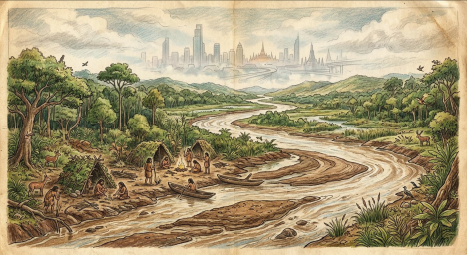
If you could travel back 12,000 years and tell your fellow ancient Southeast Asian friend, "Hey, let's go hang out at Lopburi beach," they might think you’d lost your mind (since going to the beach back then wasn't really a thing, haha!). But believe it or not, it was a geographical reality!
Back in that era, the shoreline of the Gulf of Thailand didn't sit at Bang Khun Thian like it does today. Instead, it reached deep inland, all the way up to Lopburi and Nakhon Sawan! Meanwhile, the very ground where we currently sit stuck in traffic—be it Bangkok, Nonthaburi, Pathum Thani, or Ayutthaya—didn't even exist on the map. It was a deep seabed where schools of fish swam freely.

Imagine taking a time machine back 12,000 years to the exact coordinates of modern-day
"Bangkok." Upon opening the pod door, instead of seeing Skytrain tracks, you'd have to hold your breath because you'd be submerged in the vast waters of the ancient Gulf of Thailand!
In that era, the Lower Central Plains we are so familiar with had not yet been born. Ayutthaya was a deep ocean, Pathum Thani and Nonthaburi were home to marine creatures, and Lopburi was a chic seaside resort town (if such a concept existed back then!).
As millennia rolled by, sediments carried by the Mekong, Chao Phraya, and Tha Chin rivers gradually filled the sea, building up the dry land where we construct our high-rises today. Therefore, every step we take in Bangkok today was once the swimming grounds of ancient sharks.
Think of it as a colossal land reclamation project... one that didn’t rely on dump trucks or human technology, but was driven entirely by the collaborative efforts of the Chao Phraya, Tha Chin, Mae Klong, and Bang Pakong rivers. Working 24/7 without a single day off, they have been shaping this land for over ten thousand years!

Back when the Gulf of Thailand still stretched as far inland as Lopburi, these rivers acted as "transporters," carrying soil sediment, mud, and minerals eroded from northern and western mountain ranges down south.
When the currents reached the "ancient gulf estuary" (around the Ayutthaya-Lopburi area), the water flow slowed down. This caused the heavy sediment loads to gently settle to the seabed... millimeter by millimeter, day after day, year after year.
Deep channels turned into mudflats, mudflats became clay, and eventually expanded into a massive river delta. The sea reluctantly retreated, giving rise to the most fertile, newly formed land—which we now call the "Central Plains of Thailand."
If you dig deep beneath the soils of Bangkok, Nonthaburi, or Pathum Thani, you won't encounter the solid bedrock found in other regions. Instead, you'll hit a thick layer of "Bangkok Clay." That is because these cities were built entirely by an army of sediment!
Geological data reveals that over the past 10,000 years, the upper Gulf of Thailand shrank continuously due to an astonishingly rapid rate of land formation. In certain eras, the land expanded southward by an average of 4 to 5 meters per year!
Every speck of soil you see in Bangkok today was once fragments of rocks and mountains in Chiang Mai or Sukhothai. Eroded by flash floods, they traveled hundreds of kilometers to settle beneath the ancient sea.
In short, Bangkok was not part of the original mainland. We are living on a "masterpiece of natural art" sculpted entirely from river sediment!
The Central Plains and the Gulf of Thailand are blessed not just with vast space, but with a
"10,000-year sediment buffet" gifted by the rivers!
On Land = A World-Class Kitchen
Sediment from the four main rivers deposited natural fertilizers to create the "Central Plains Clay"—a soil famed for growing the most fragrant rice and the sweetest, juiciest fruits, thanks to its dense nutrient profile!
In the Water = A Seafood Supermarket
The nutrient-rich mud flowing into the ancient gulf became a favorite feast for plankton. With an abundance of plankton, shrimps, shellfish, crabs, fish, and even Bryde's whales gathered in droves. Consequently, the Gulf of Thailand became one of the most bountiful fishing grounds.
Think about it: The Tom Yum Goong, crab fried rice, or fried mackerel you eat today... the secret behind their world-class deliciousness started with mud accumulating 12,000 years ago!

Finally, we arrive at the ultimate conclusion. Before becoming the Bangkok we know today, this territory underwent intense physical, political, and cultural transformations. The last 244 years—and the years to come—represent the Rattanakosin era, a time that beautifully preserves Thailand's story through its culinary arts. It is here that centuries-old heritage seamlessly blends with modern Thai cuisine.
Experience the authentic flavors of Rattanakosin-era Thai cuisine for yourself. Come and try it at Jirakaan Restaurant, Sukhumvit 51.
"Come and savor Rattanakosin-style Thai cuisine—the authentic food of Bangkokians, meticulously crafted over a 244-year legacy... at Jirakaan Restaurant."


